Publication Context
This case study reviews the peer-reviewed research paper introducing FirmwareDroid, presented at the 10th IEEE/ACM International Conference on Mobile Software Engineering and Systems (MOBILESoft 2023).
Paper Title: FirmwareDroid: Towards Automated Static Analysis of Pre-Installed Android Apps
Authors: Thomas Sutter, Dr. Bernhard Tellenbach
Affiliations: Institute of Applied Information Technology, Zurich University of Applied Sciences (ZHAW), Winterthur, Switzerland & Cyber-Defence Campus, Armasuisse, Zurich, Switzerland
Conference: 2023 IEEE/ACM 10th International Conference on Mobile Software Engineering and Systems (MOBILESoft 2023, co-located with ICSE 2023), Melbourne, Australia
Publisher: IEEE
DOI: 10.1109/MOBILSoft59058.2023.00009
IEEE Xplore: https://ieeexplore.ieee.org/document/10172951
The Research Problem
Android smartphone users encounter two distinct classes of software:
- User-Installed Apps: Downloaded from application stores (such as Google Play), governed by runtime permission prompts, sandboxed, and easily uninstalled or reviewed by users.
- Pre-Installed Apps: Shipped directly on device firmware images by device manufacturers (OEMs), operating system vendors (OSVs), mobile network operators, or third-party partners.
Despite their ubiquity, pre-installed applications represent a major security and privacy blind spot:
- Lack of User Control: Users cannot choose which software is pre-installed on their devices, and these applications cannot be easily uninstalled through standard system settings.
- Privileged Access: Pre-installed apps often inherit elevated system and signature-level permissions without requiring runtime user consent or interactive authorization.
- Supply Chain Risks: Real-world incidents—such as the Chamois and Triada malware families—demonstrate that malicious code can infiltrate vendor supply chains, infecting millions of devices while remaining undetected for months.
- Privacy and Tracking: Pre-installed software frequently bundles third-party advertising and analytics trackers, raising compliance concerns under privacy regulations such as the GDPR and CCPA.
- Analysis Bottlenecks: Android firmware images use customized compression combinations and non-standard partition formats. Prior research frequently relied on manual firmware unpacking or crowd-sourced APK collection, neither of which scales to full-firmware components, OS dependencies, or verifiable cross-vendor comparisons.
FirmwareDroid was designed to address this challenge by providing an automated, open-source framework capable of extracting, processing, and statically analyzing pre-installed Android software at scale without requiring physical hardware.
System Design & Architecture
FirmwareDroid implements a modular, five-stage pipeline orchestrated with Docker and Docker Compose to automate firmware acquisition, unpacking, worker task queuing, static inspection, and report aggregation.
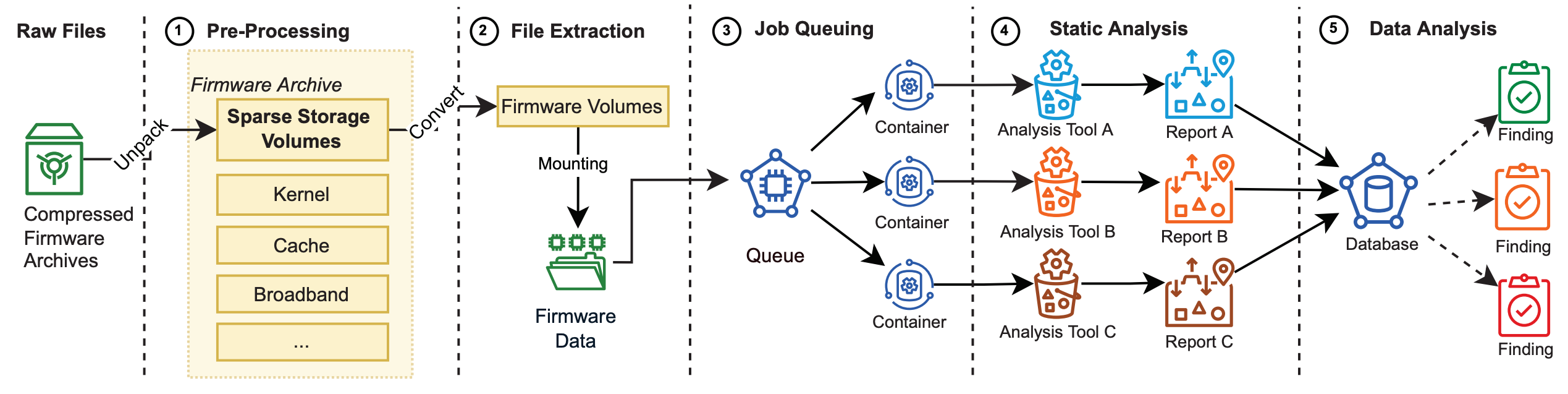
Note: Architectural overview diagram reproduced from the original MOBILESoft 2023 research paper (Sutter & Tellenbach: “FirmwareDroid: Towards Automated Static Analysis of Pre-Installed Android Apps”, IEEE/ACM 2023).
The Five-Stage Analysis Pipeline
- Firmware Pre-Processing:
Firmware archives frequently utilize nested compression algorithms (for example, Brotli-compressed files within zip archives containing.datimages). FirmwareDroid implements a recursive decompression routine supporting eight compression formats (including Brotli andnb0) to extract raw partition images. - File Extraction:
Android partition files (such assystem,vendor, oroem) typically use Sparse or Yaffs2 formats with non-standard naming schemes. FirmwareDroid applies regular expression matching across partition names and converts Sparse images usingsimg2img, mounting modified filesystems using thefuseext2kernel module. For images where mounting fails, it falls back to direct user-space file extraction usingimgpatchtoolsorubi-extract. The framework extracts.apk,.vdex,.odex,.dex, and.artfiles to persistent storage. - Job Queuing & Scalability:
A centralized job queue distributes extracted binaries across decoupled container instances. Running on a single virtual server with 32 CPU cores (Intel Broadwell) and 128 GB RAM, the framework achieved an average throughput of ≈ 55,000 scanned applications per day. - Static Analysis Integration:
FirmwareDroid packages an initial set of eight open-source static analysis tools in isolated Docker containers:- AndroGuard: Manifest parsing, permission extraction, certificate extraction, and string analysis.
- Exodus: Detection of known advertising and tracking libraries using curated rule signatures.
- Additional Integrated Scanners: Androwarn, SUPER Android Analyzer, QARK, QuarkEngine, APKiD, and APKLeaks.
(The empirical study presented in the paper specifically focuses on findings from AndroGuard and Exodus).
- Data Analysis & Dynamic Storage:
Because external static analysis tools generate differing and evolving JSON or text report formats, FirmwareDroid stores output reports in a NoSQL database utilizing a dynamic schema, avoiding brittle relational migrations.
Dataset & Empirical Methodology
To ensure reproducible measurements and eliminate the risk of tampered third-party ROMs, the authors gathered only official firmware images published with cryptographic checksums directly from vendor channels in July 2021.
Firmware Corpus Composition
FirmwareDroid collected 6,169 firmware samples across seven operating system vendors (OSVs) and successfully unpacked 5,728 samples (441 samples failed import due to unrecognized formats or naming patterns: 297 OmniROM, 92 RROS, 46 Carbon, and 6 Google):
| ROM / OS Vendor | Unpacked Firmware | Total Apps Extracted | Unique Package Names | Unique Apps (SHA-256) |
|---|---|---|---|---|
| 1,023 | 169,392 (19.92%) | 652 (0.38%) | 37,255 (21.99%) | |
| GrapheneOS | 18 | 3,597 (0.42%) | 243 (6.67%) | 2,131 (59.24%) |
| Paranoid Android | 99 | 19,332 (2.27%) | 322 (1.67%) | 1,616 (8.36%) |
| CarbonROM | 1,300 | 68,901 (8.10%) | 317 (0.46%) | 2,725 (3.95%) |
| LineageOS | 644 | 122,838 (14.44%) | 457 (0.37%) | 4,620 (3.76%) |
| OmniROM | 2,107 | 292,879 (34.43%) | 503 (0.17%) | 15,815 (5.40%) |
| Resurrection Remix OS (RROS) | 537 | 173,616 (20.41%) | 688 (0.40%) | 10,979 (6.32%) |
| Total | 5,728 | 850,555 | 3,182 (0.37%) | 75,141 (8.83%) |
Across the corpus, Android 10 (40.89%) and Android 11 (13.88%) represented the majority of modern releases, alongside Android 9 (10.68%), Android 7 (4.99%), Android 8 (2.88%), earlier legacy versions (v4–v6, 1.15%), and images with unparsed versions designated v0 (25.52%).
While the corpus yielded 850,555 total application instances, deduplication by SHA-256 revealed 75,141 unique application builds across 3,182 unique package names, illustrating substantial build variation across distinct firmware releases.
Key Empirical Findings
The study investigated two primary research questions regarding pre-installed applications: their declared permission profiles (RQ1) and the prevalence of embedded advertising and tracking libraries (RQ2).
1. Permission Usage & Over-Privileging (RQ1)
Using AndroGuard to extract declared permissions from AndroidManifest.xml files across all pre-installed apps, the authors classified permission usage into the three primary Android protection levels:
1
2
3
4
Declared Permission Breakdown Across All Vendors:
├── Signature Permissions: 88.14% (Predominant permission class)
├── Normal Permissions:     8.21%
└── Dangerous Permissions:  3.56% (55,859 declarations)
Key Observations on Permissions:
- Dominance of Signature Permissions: 88.14% of all declared permissions were signature-based. Signature permissions grant privileged access if the requesting application is signed with the same key as the declaring component, frequently providing access to sensitive system internals (e.g.,
PackageManager) without runtime user consent prompts. - Dangerous Permission Reduction in Android 11: On Google firmware, declared dangerous permissions dropped significantly from 10.22% in Android 10 to 3.60% in Android 11, while normal permissions rose to 23.83%.
- Vendor Variations:
- Resurrection Remix OS (RROS): Exhibited the highest proportion of signature permissions (338,758 declarations, 95.91%) and the lowest dangerous permission rate (801 declarations, 0.23%).
- GrapheneOS: Demonstrated the highest proportion of normal permissions (59.54%) and 35.26% signature permissions.
- LineageOS: Maintained a low dangerous permission rate of 3.08% on Android 11.
- Custom Third-Party Permissions: Out of 1,113 total distinct permission definitions detected across Android 10 and 11, 28.57% (318 permissions) originated from third-party vendor packages, alongside 46.54% (518) in
android.*, 18.78% (209) incom.google.*, and 6.11% (68) incom.android.*. - Most Requested Dangerous APIs: Storage and device identifiers topped the list of requested dangerous permissions:
android.permission.WRITE_EXTERNAL_STORAGEandroid.permission.READ_EXTERNAL_STORAGEandroid.permission.READ_PHONE_STATEandroid.permission.READ_CONTACTSandroid.permission.ACCESS_FINE_LOCATIONandroid.permission.GET_ACCOUNTS
- Stratified Sampling Verification: To account for sample size disparities across vendors, the authors randomly sampled 1,000 unique apps (by SHA-256) per vendor for Android 8 and above. Google apps declared the lowest number of dangerous permissions (32 permissions, 1.19% of its sample), while Paranoid Android declared the highest (197 permissions, 2.40%). Signature permissions remained the dominant category across every vendor evaluated.
2. Advertising & Tracker Libraries (RQ2)
Scanning 850,147 pre-installed applications with Exodus (408 apps failed to scan due to scanner crashes), the authors identified 41,175 total tracker instances across the dataset.
Total Tracker Detections Across Pre-Installed Apps:
| OS Vendor | Apps With ≥1 Tracker | Apps Without Trackers | Total Scanned Reports | % of Apps With Trackers |
|---|---|---|---|---|
| 19,757 | 149,544 | 169,392 | 11.66% | |
| GrapheneOS | 0 | 3,597 | 3,597 | 0.00% |
| Paranoid Android | 1,279 | 18,053 | 19,332 | 6.62% |
| CarbonROM | 415 | 68,486 | 68,901 | 0.60% |
| LineageOS | 162 | 122,676 | 122,838 | 0.13% |
| OmniROM | 879 | 291,998 | 292,877 | 0.30% |
| Resurrection Remix OS | 2,105 | 171,105 | 173,210 | 1.22% |
| Total Corpus | 24,597 | 825,459 | 850,147 | 20.53%* |
*Note on Statistics: The paper reports 20.53% (and 24,597 apps) in Table IV and the text. As an aggregate percentage across all 850,147 individual app reports, 24,597 apps represents 2.89%; the 20.53% value corresponds to the sum of the vendor-level percentages (11.66% + 6.62% + 1.22% + 0.60% + 0.30% + 0.13% + 0.00%).
Key Tracker Observations:
- Commercial vs. Privacy-Focused ROMs: Commercial Google firmware contained the largest volume of tracking libraries by far, with 32,238 tracker instances across 19,757 apps (11.66%). In contrast, privacy-centric distributions showed near-zero tracker presence: LineageOS contained only 188 trackers (0.13% of apps), and GrapheneOS contained 0 detected trackers (0.00%).
- Most Prevalent Tracker Libraries: Google services accounted for the overwhelming majority of detected tracker instances:
- Google Firebase Analytics: 13,075 detections (31.74% of all detected trackers)
- Google Analytics: 12,280 detections (29.85%)
- Google AdMob: 6,946 detections (16.87%)
- Google Tag Manager: 2,751 detections (6.68%)
- Amazon Analytics (Insights): 1,327 detections (3.22%) — peaked in Google Android 8 builds (1,168 instances) before declining sharply in newer releases.
- OpenTelemetry / Tracing: 1,010 detections (2.45%)
- Facebook Analytics / Share / Login: Only 63 detections each (0.15% of trackers).
- Discrepancy with App Store Findings: While the Exodus community reports that ~18% of user-installed Google Play Store apps contain Facebook Analytics, only 63 instances (0.15%) appeared in the pre-installed firmware corpus. The authors noted this could reflect static analysis limitations, signature evasion, or distinct tracking architectures in system apps.
- Stratified Tracker Comparison (1,000 Apps/Vendor): Under stratified sampling, 84.7% (847 apps) of randomly sampled Google apps contained at least one tracker, compared to 0% in GrapheneOS, 0.4% in LineageOS, 0.5% in CarbonROM, 1.4% in OmniROM, 1.5% in Paranoid Android, and 1.8% in RROS.
Technical Limitations & Threats to Validity
The paper transparently documents several critical technical constraints inherent in static firmware analysis:
- Dalvik Bytecode Optimization (
.odex/.vdex/.art):
Modern Android Runtime (ART) splits and pre-compiles application bytecode into architecture-specific optimization formats. Consequently, analyzing standalone.apkarchives fails to capture the full runtime code executed on devices. FirmwareDroid extracted these optimized files but noted the lack of an automated de-optimization module to reconstruct complete APKs for downstream scanners. - Native Shared Libraries (
.so):
None of the integrated static analysis tools inspected native C/C++ libraries for vulnerabilities or malicious code, leaving potential native SDK exploitation unexamined. - Declared vs. Runtime Permissions:
Manifest parsing records declared capabilities but cannot verify whether permissions are actively exercised at runtime. - Scanner-Specific Failures and False Positives:
- Exodus crashed on 408 applications.
- SUPER Android Analyzer was only capable of scanning 51% of the application corpus due to internal tool errors.
- QARK and AndroGuard’s call-graph features exhibited severe scaling limits, requiring minutes to hours per large APK.
- APKleaks produced an estimated false positive rate exceeding 90%, primarily because it erroneously flagged standard SHA-256 package hashes in
MANIFEST.MFas hardcoded cryptographic API secrets.
Reproducing the Study with Modern FirmwareDroid
Researchers can reproduce and extend the findings from the MOBILESoft 2023 paper using the open-source FirmwareDroid stack:
- Deploy FirmwareDroid via Docker Compose:
1
2
3
git clone https://github.com/FirmwareDroid/FirmwareDroid.git
cd FirmwareDroid
docker compose -f docker-compose-release.yml up -d
- Batch Import Firmware Images:
Use the Python client or GraphQL API (detailed in Exploring the API) to queue firmware archives for automated unpacking and scanner dispatch. - Query Consolidated Findings:
Execute GraphQL or MongoDB queries against the dynamic report database to evaluate permission levels, certificate signatures, and tracker rules across target firmware samples.
Academic Citation
If you use FirmwareDroid in your academic research or build upon these empirical findings, please cite the original MOBILESoft 2023 paper:
1
2
3
4
5
6
7
8
9
@INPROCEEDINGS{FirmwareDroid,
  author={Sutter, Thomas and Tellenbach, Bernhard},
  booktitle={2023 IEEE/ACM 10th International Conference on Mobile Software Engineering and Systems (MOBILESoft)},
  title={FirmwareDroid: Towards Automated Static Analysis of Pre-Installed Android Apps},
  year={2023},
  month={May},
  pages={12-22},
  doi={10.1109/MOBILSoft59058.2023.00009}
}
Text Citation
Sutter, Thomas and Tellenbach, Bernhard. “FirmwareDroid: Towards Automated Static Analysis of Pre-Installed Android Apps.” 2023 IEEE/ACM 10th International Conference on Mobile Software Engineering and Systems (MOBILESoft), Melbourne, Australia, 2023, pp. 12–22. DOI: 10.1109/MOBILSoft59058.2023.00009.